

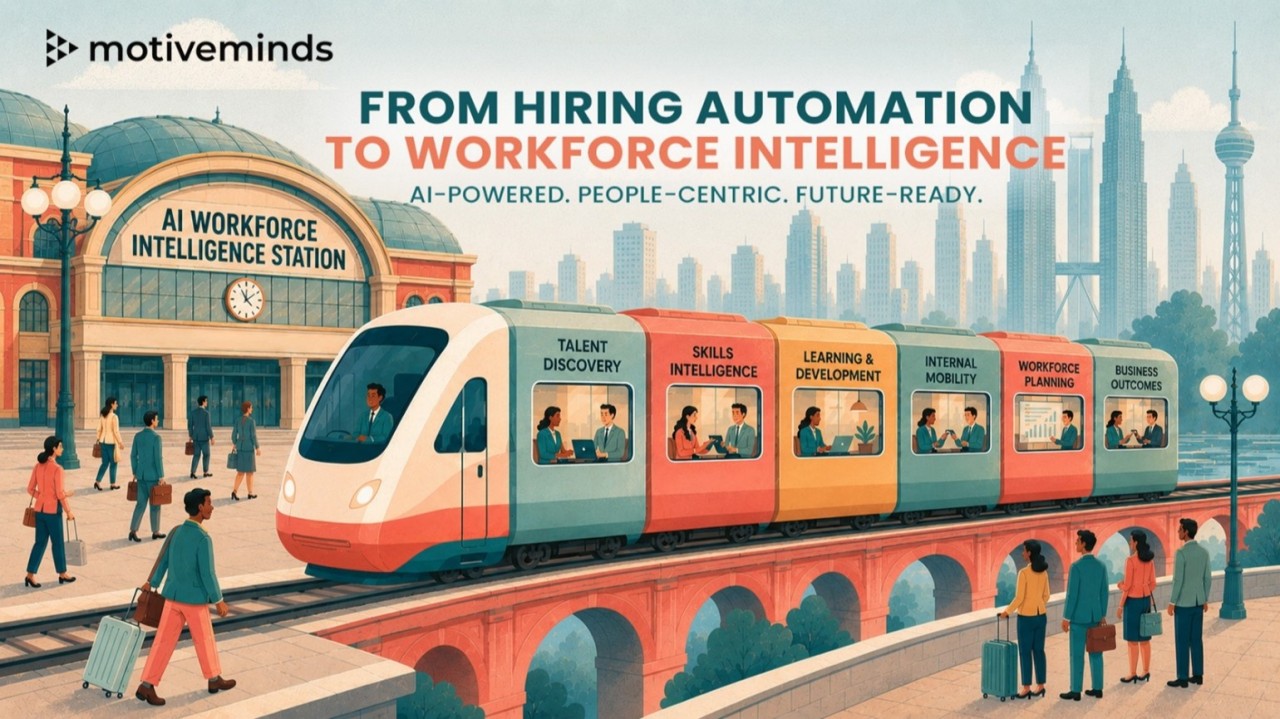
Welcome to the second issue of AI Signals by Motiveminds - a newsletter for business, technology and transformation leaders who are asking a practical question: How do we move AI from experimentation to measurable enterprise value? This newsletter is not about chasing AI hype. It is a field note from our work with enterprise teams - what we see while designing, building and deploying AI solutions in real business environments. In this issue, we discuss the implementation of Talent Acquisition process under Workforce Intelligence at a large, research-driven pharmaceutical company.
AI-Powered Talent Acquisition in Workforce Intelligence at a Global Pharmaceutical Enterprise
One of the recurring enterprise challenges in talent acquisition is not the lack of data, but the fragmentation of workforce intelligence across systems, processes, and decision layers. Our work focused on building an AI-enabled approach to intelligent CV-to-JD matching within existing HRMS environments. The objective was not simply to automate resume screening, but to improve the quality, speed, and contextual relevance of talent discovery across internal and external candidate pools.
The solution addressed five key dimensions:
- Intelligent candidate-to-role matching using semantic and skill-based analysis.
- Internal mobility recommendations based on transferable capabilities and adjacent skills.
- Skill-gap identification across business units and functions.
- Workforce readiness analysis aligned to future capability requirements.
- Talent discovery across fragmented HR and enterprise systems.
Rather than treating employee records as static profiles, the system explored the concept of a dynamic skill graph - a continuously evolving organizational intelligence layer that maps relationships between people, skills, experiences, projects, functions, and business priorities. The skill-graph semantic layer opens future possibilities in workforce planning, risk detection, and capability mapping. This represents a shift away from traditional org-chart thinking toward a more contextual and adaptive model of enterprise capability visibility. The broader solution direction positions AI as an enabler of workforce intelligence, helping organizations better understand skill availability, readiness, and internal talent movement.
The implications extend beyond recruitment efficiency. A mature skill-graph layer creates possibilities for:
- Strategic workforce planning.
- Succession and leadership pipeline visibility.
- Capability risk detection.
- Learning and development alignment.
- Internal talent marketplace models.
- Enterprise-wide skill and expertise mapping.

Leadership Insight
Enterprise AI Creates Value When It Understands Context
A key insight from this engagement was that talent decisions cannot rely on static data or keyword-based automation alone. The real value emerged when AI began connecting skills, roles, experiences, and internal mobility patterns into the skill-graph layer to create broader workforce visibility. This reflects a larger shift in enterprise AI: organizations must move from isolated automation toward contextualized intelligence systems that improve decision-making across functions.
Closing Thoughts
From Hiring Automation to Workforce Intelligence
What started as an AI-driven CV-to-JD matching initiative is evolving into a broader workforce intelligence conversation - one focused not just on filling roles, but on understanding where skills live, how talent can move, and where future capability gaps may emerge.
The long-term opportunity is in building an organizational intelligence layer that helps enterprises see their workforce clearly - across functions, levels, and time horizons. The organizations of future will be the ones embedding workforce intelligence into how they plan, grow, and make decisions - every day.
