

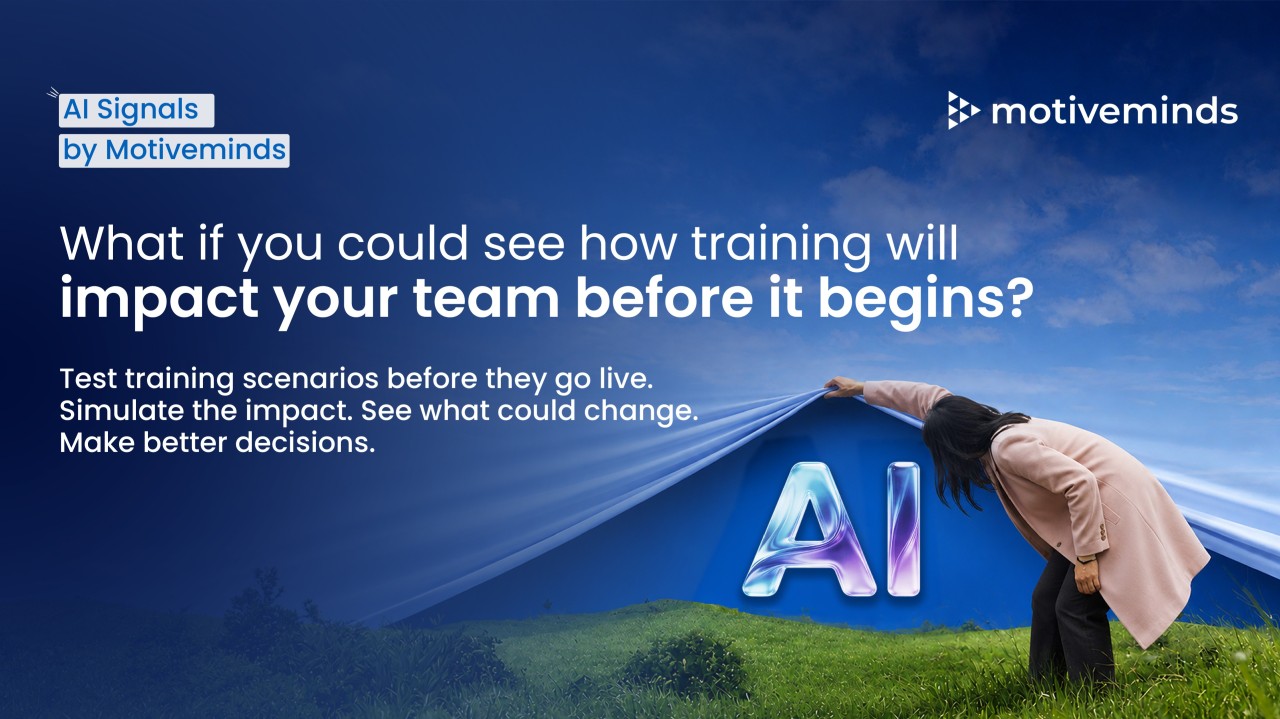
Welcome to Issue 4 of AI Signals by Motiveminds - where we bring you practical stories and sharp thinking from the frontlines of enterprise AI.
What if you could rehearse the future?
The case for Digital Twin Simulation in Enterprise Training
Every organization trains its people. And almost every organization struggles with the same nagging question afterwards: did it actually work?
Not “did people show up” or “did they pass the assessment.” But did the training move the needle on performance? Did it change behavior on the floor, in the field, or in front of the customer? Did it connect, in any measurable way, to business outcomes?
For most organizations, the honest answer is: we’re not entirely sure. Training ROI has always been notoriously hard to measure. The gap between the classroom and the outcome is wide, and the variables in between are many.
What if you could run the training virtually before rolling it out — and see the likely impact before a single rupee or hour was spent on execution?
That is the question at the heart of digital twin simulation for enterprise training. And it is exactly what we are building.
How Digital Twin Simulation works in this context
A digital twin, in its simplest form, is a virtual replica of a real-world system. In manufacturing, it might mirror a production line. In logistics, a supply chain. In our context, the “system” being replicated is the relationship between training interventions and business performance.
The simulation environment is built on real organizational data - historical training records, employee performance metrics, sales outcomes, and behavioral signals. On top of that foundation, we layer a correlation engine that maps the relationships between training inputs and performance outputs.

The result is not a guarantee of outcomes. It is something arguably more valuable: clarity on the likely range of outcomes, the variables that influence them most, and where the training design needs to be strengthened before it goes live.
Think of it as a dress rehearsal — where you test training scenarios and their potential business impact before going live.
Training Impact Simulation at a global premium auto brand
Our customer is a globally recognized premium automotive brand operating across a large, distributed salesforce in India. Training their people is not just a learning objective — it is a business-critical function tied directly to customer experience and sales performance.
The challenge they brought to us was familiar but complex: how do you know which training programs are actually driving sales? And more importantly, how do you design the next one with greater confidence that it will work?
What we built:
- A correlation engine that links specific training activities to sales performance metrics — identifying which programs have historically moved the needle and by how much.
- A digital twin simulation environment where new training scenarios can be tested virtually before real-world rollout.
- What-if scenario modelling — allowing stakeholders to ask “if we run this program for this cohort, what is the likely impact on performance outcomes?”
- A training impact dashboard that gives L&D and business leaders a shared view of ROI projections and performance correlations.

The business impact goes beyond smarter training design. It changes the conversation between L&D and business leadership entirely. Training decisions are no longer based on intuition or anecdotal evidence. They are grounded in simulated data, historical correlation, and projected business outcomes.
That shift — from “we think this will work” to “here is what the simulation shows” — is quietly transformational.
Leadership insight
The Simulation is the Strategy
The most interesting shift in enterprise AI right now is not about the technology getting smarter. It is about organizations getting more intentional. The question is no longer whether AI can do something useful. It is whether organizations have the design thinking to deploy it in ways that are measurable, trustworthy, and genuinely impactful.
Digital twin simulation is one of the clearest examples of this shift. It does not promise magic. It promises a better rehearsal. And in enterprise environments where mistakes are expensive and change is slow, a better rehearsal might be the most valuable thing AI can offer.
In the room
Workday Rising India — Bengaluru | SAP Executive Exchange — Delhi & Pune
The last few weeks have been busy ones. We were part of Workday Rising India in Bengaluru and SAP Executive Exchange across Delhi and Pune — and both were reminders of how much the conversation around AI in enterprise has shifted.
A year ago, the dominant question was “should we explore AI?” Today, the question in every room is “how do we deploy it responsibly, and where do we start?” That is a meaningful shift — and an encouraging one.
